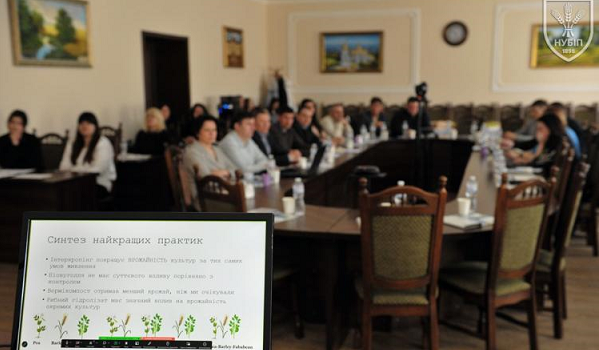
On April 15, a landmark event took place at the National University of Life and Environmental Sciences of Ukraine, dedicated to strategies for sustainable development and the agroecological intensification of crop production. The event marked one of the final stages in the implementation of the international ECOTWINS project, “Research capacity building and upskilling and upgrading the research team in NUBiP (Ukraine) on agroecological intensification for crop production,” funded by the Horizon Europe Framework Programme (HORIZON) under Grant Agreement No. 101079308.
The event was opened by the project coordinator, Vice-Rector for Research and Innovation at NUBiP of Ukraine, Professor Oksana Tonkha. In her presentation, she emphasized that the university’s participation in the Horizon Europe programmes serves as a powerful instrument for enhancing the qualifications of researchers and fostering integration into the European Research Area. Professor Tonkha highlighted that the outcomes of the project will provide a solid foundation for strengthening the practical component of educational programmes and for implementing innovations directly into agricultural production, thus facilitating the transition from conventional crop production technologies to sustainable agronomic practices. Particular attention during the workshop was devoted to soil health issues, specifically biological activity, soil organic matter, and physical condition under the use of intercropping systems and biostimulants. This reflects the understanding that achieving high yields is important, but equally critical is the preservation of soil fertility and biodiversity.

The responsible executor of the project, Associate Professor Bohdan Mazurenko, presented the results of three-year research on intercropping systems. He noted that cultivating a three-component mixture of pea, faba bean, and barley resulted in increased productivity: protein yield per hectare rose by more than 50% compared to monocropping systems, while the land equivalent ratio (LER) at the level of 1.4–1.5 demonstrates that farmers obtain significantly more output from the same unit of land. At the same time, intercropping systems naturally suppress weeds and promote better soil aeration, which is essential for maintaining soil health. During the discussion, participants, including representatives of agribusiness, shared practical insights on the application of biostimulants and organic fertilizers.

A highlight of the event was the presentation of an innovative biostimulant—Insect Frass. This product attracted considerable attention due to its high efficiency in enhancing crop productivity and improving soil fertility indicators.
Participants of the event, both those attending in person and those joining online, conducted a practical calculation of the carbon footprint using the methodology developed by Sahar Azarkamand (ESCI Higher School of International Business).

The next presentation focused on organic biostimulants and their specific applications, delivered by ECOTWINS project participant Md Nasir Hossain Sani from the Swedish University of Agricultural Sciences (SLU).
Professor Nataliia Raksha presented the development of innovative biostimulants at the Research and Production Center “Forel,” based on fish processing by-products. Tetiana Hnatiuk introduced the “Atlas of Bacterial Diseases of Legumes.”
During the workshop, participants outlined future steps for collaboration, including joint activities within new Horizon Europe projects.