Strong agriculture begins with people, and strong people in agribusiness begin with quality education: conclusions of the week in the USA
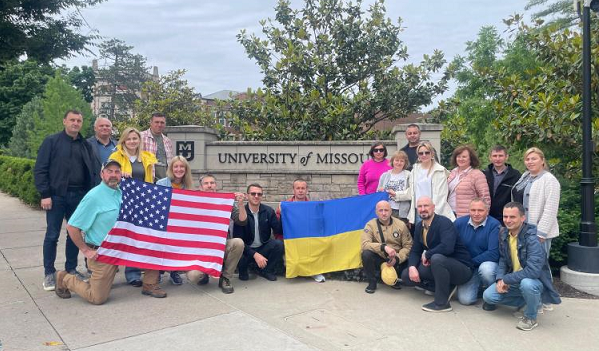
I would like to share my impressions of my week in the United States. I have always known that this is a country of opportunities and high technologies, where every person can feel independent. Several times I could not bring myself to take such a long trip, but this time I am here with AgroScouts from Ukraine. The visit is taking place with the support of the U.S. Government, provided through the AGRO Program — the Agriculture and Rural Development Program – AGRO.

On the first day, which was very symbolic, as it coincided with Science Day in Ukraine, we visited one of the largest scientific and educational centers in the United States — the Saint Louis Science Center in the city of St. Louis 🇺🇸. This place combines modern science, technologies, interactive exhibitions, and the practical popularization of research for society. An extraordinary impression was made by the unique collection of soil monoliths from different states of America — full-profile soils from across the country. This provides an opportunity to see how diverse the natural conditions of the United States are and how exactly soil shapes the agricultural specialization of regions. Modern agricultural technologies, from simple to complex, are presented very simply, often in a playful format for children and the general public, showing how they transform modern agriculture. Such centers once again demonstrate how important it is to popularize agricultural science, modern technologies, and understanding of natural resources among youth and society. I was impressed by the fact that so many children are playing in the museum, and there are no strict requirements about where and how to walk. Science is interesting and presented in an accessible form!

We also visited the unique Gateway Arch National Park in St. Louis, Missouri, known for its 192-meter Arch. This is the smallest national park in the United States, which honors the role of the city in the development of the American West. A tram delivered us to the top, from which a unique view of the Mississippi River opened. We also saw interactive galleries about the history of the United States and the construction of the monument, entrance to which is completely free, and the Old Courthouse — a historic building where well-known civil rights cases were heard.
On the first practical day in the United States 🇺🇸🌱, we visited the Service & Supply cooperative (Bellflower), where we became familiar with field scouting and service provision. Employees of the cooperative, while performing daily field work, simultaneously monitor crops, analyze crop conditions, record problems, and promptly transfer data for decision-making. Special attention is paid to precision agriculture and the integration of digital technologies. We were shown the operation of artificial intelligence systems that, using cameras and sensors, identify weed patches and allow local application of herbicides only where necessary. In some fields, this makes it possible to treat less than half of the area, significantly reducing costs and environmental pressure. An important element of the American model is the constant cooperation of farmers and cooperatives with the University of Missouri (Mizzou). It is the university that forms the scientific base: conducts research, tests technologies, analyzes the effectiveness of solutions, while producers quickly implement the results into practice.
It was interesting to visit one of the largest auction centers for young cattle sales in the state of Missouri — Callaway Livestock Center — the American livestock market: formation of lots, animal evaluation, digital monitoring systems, and the auction process itself, which takes place very quickly, clearly, and in a highly organized manner.
At the Greenley Research Center, a particularly strong impression was made by the interactive sandbox for terrain modeling 🌎. With the help of sensors, projections, and digital technologies, the system shows in real time: water movement across the surface; formation of erosion processes; the impact of terrain on moisture accumulation; features of landscape management; the relationship between topography and agricultural production. In fact, this is a visual model of how natural processes work in the field — from water runoff to risks of soil erosion. Such solutions are actively used in the United States for teaching students, training agronomists, agro-scouts, and precision agriculture specialists. It is very impressive to see how complex scientific processes can be explained so simply, interactively, and practically 🌱🇺🇸
MFA Incorporated: how farmer cooperation, agro-scouting, and precision agriculture work in the USA 🇺🇸🌱 — one of the largest regional farmer-owned supply and marketing cooperatives in the state of Missouri, founded back in 1914.
Today, MFA is not just a traditional cooperative but a powerful agri-service system uniting more than 45,000 farmer-owners across several states. It provides a full-cycle support model — from inputs (seeds, fertilizers, crop protection, feed) to agronomic consulting, field data analysis, and tailored recommendations. Agro-scouting here is not just field observation — it is part of a broader analytical process where each observation leads to a concrete decision: adjusting application rates, optimizing crop protection, refining nutrition, or reducing costs. Special attention is given to variable-rate fertilizer application, where agronomists develop field maps based on soil variability and productivity zones, helping farmers manage fields not “on average” but site-specifically.
An important takeaway is that services are shaped directly by farmers’ needs — from basic support to full agronomic сопровід with deep analytics and continuous guidance. This experience clearly shows how cooperation can serve not only as an economic model but also as a driver of technological development, access to knowledge, and modern precision agriculture solutions.
In the next post, I will share insights about agricultural education, the role of universities and communities, and what Ukraine can learn from the U.S. experience.
Material prepared by:
Oksana Tonkha,
Iryna Ishchenko,
Yurii Savchuk,
Nataliia Tabinska