Education, Communities, and the Future of Agriculture: Lessons from the U.S.
In this post, I would like to share key insights about agricultural education, the role of universities, and community development in the United States — and what Ukraine can learn from this experience.
Our program in the U.S., and especially its substantive part, is supported by the University of Missouri in Columbia — the first public university west of the Mississippi River, founded in 1839. The campus was built on the principle that a university should be part of society, and knowledge should contribute to the development of territories and the economy. This idea is strongly felt here.

Today, the university has more than 35,000 students, hundreds of research programs, and one of the strongest applied agricultural education systems in the region. The campus covers over 500 hectares and feels like a separate city — with open spaces, research facilities, and infrastructure designed for both learning and community life.

The agricultural direction here is highly systematic: greenhouses, botanical gardens, research plots, and laboratories for soil science, crop production, and precision agriculture. Many research activities are directly integrated into the needs of farmers in the state. It is clear that agricultural education here has been built over decades as a practical infrastructure for the development of agriculture.
We also worked closely with the University of Missouri team and extension specialists, who introduced us to one of the key features of the U.S. agricultural system — the land-grant university model. These universities combine education, scientific research, practical advisory services, and direct work with farmers and communities. This system has been shaping the development of U.S. agriculture for decades.
One of the key speakers was Rob Kallenbach, Assistant Dean for Agriculture and Environment Extension. He explained how the extension service operates — covering almost the entire state through a network of field specialists, local offices, and experts. This is not theory — it is daily practical work: field consultations, farmer training, demonstration plots, workshops, and implementation of research results directly in farming practice. The university here acts as a постоянний partner for farmers.

Special attention was given to the agricultural education system in the U.S., which is multi-level and starts as early as school 🌾
Where does it begin? Agricultural education in the U.S. starts long before university. It is highly practical and focused on:
– giving students real production tasks, not just theory;
– building partnerships between schools and local farmers;
– preparing teachers who understand modern agriculture;
– creating youth agricultural communities as entry points into the profession.
“Learning by doing” here is not just a phrase — it is the core principle. Students are involved in real projects, field research, and collaboration with farmers from the early stages of their education. In Ukraine, agricultural education is traditionally strong in theory, but sometimes there is still a gap between classroom knowledge and real field practice. This may be our growth point.
At the same time, challenges are similar in both countries: how to attract young people to agriculture and how to ensure that education keeps pace with rapid changes in the industry.
What stands out most is the role of the university as a resource for the community, not a closed institution. Specialists work daily with farmers — consulting, training, and helping implement new practices. The university is not an “ivory tower” but a living system that supports the entire agricultural region.
We also explored community-based agriculture and urban farming 🌱
The Columbia Farmers Market is one of the most well-known farmers’ markets in Missouri and clearly demonstrates the American approach to local food systems. It is not just about selling products — it is about trust between producers and consumers, transparency, and shared values around quality, soil health, and sustainability.
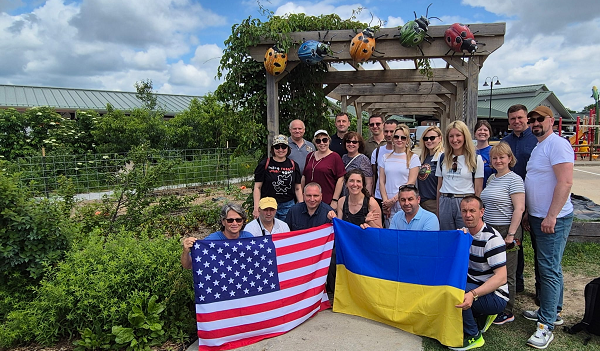
Another inspiring location was the Columbia Center for Urban Agriculture. This organization combines urban farming, education, community support, social initiatives, regenerative agriculture, and healthy food systems. On about 3 acres of land, they grow nearly 20 tons of organic produce annually, part of which is donated to veterans, low-income families, and local food programs. This is agriculture not only as production, but as a tool for community support and social impact.
This experience is especially valuable for Ukraine today, as we also need new models of interaction between agricultural education, communities, veterans, youth, and local initiatives.

Key takeaways from this week in the U.S.:
• agricultural education must be systemic and start from school;
• more practical learning and real-life cases are essential;
• community development is not a project, but a continuous process;
• agriculture is part of social development and integration;
• universities must go beyond classrooms;
• responsible environmental practices are implemented in reality, not just declared;
• young people see agriculture as innovation, opportunity, and future.
Material prepared by:
Oksana Tonkha
Iryna Ishchenko
Yurii Savchuk
Nataliia Tabinska