SCIENTIFIC SOLUTIONS FOR A CLIMATE-RESILIENT FUTURE: NUBIP OF UKRAINE AT COP31 IN TURKEY
The 31st session of the UN Climate Change Conference (COP31) is underway in Antalya, Turkey. Representatives of governments, the scientific community, business, and civil society are discussing ways to reduce greenhouse gas emissions, transition to clean energy, and secure climate adaptation finance. These issues are becoming increasingly urgent against the backdrop of rising global temperatures: according to preliminary estimates by the World Meteorological Organization, 2026 is set to rank among the four warmest years on record. Alongside international agreements, participants' attention is focused on practical solutions that will help countries and communities prepare for climate challenges. Science plays a crucial role in their development, particularly research in soil conservation, rational use of natural resources, and enhancing agricultural resilience.
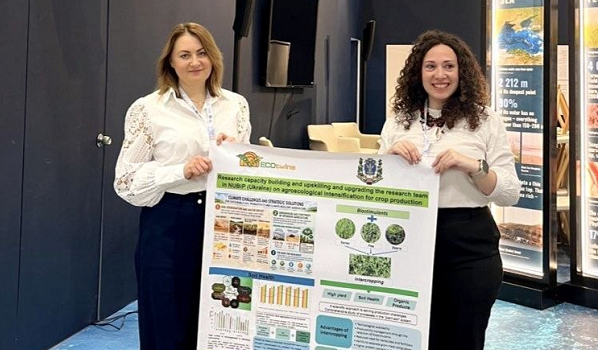
Representatives of the National University of Life and Environmental Sciences of Ukraine (NUBiP) participated in the conference — project participants of Horizon Europe ECOTWINS: Olha Kravchenko, Associate Professor at the Department of Analytical and Bioinorganic Chemistry and Water Quality, and Olena Pikovska, Associate Professor at the Department of Soil Science and Soil Conservation named after Prof. M. K. Shykula. The scientists were accredited through the submission of the Ministry of Agrarian Policy and Food of Ukraine and joined the events at the Ukrainian Pavilion. They presented the university's experience in implementing agronomic practices aimed at soil conservation and enhancing the resilience of agricultural production to climate change.

In particular, university representatives shared the results of the ECOTWINS project, which pays special attention to soil health and its significance for sustainable agriculture. The research, led by the project coordinator, Vice-Rector for Research and Innovation of NUBiP of Ukraine, Professor Oksana Tonha, demonstrated the prospects of using biostimulants and intercropping to support plant productivity under adverse weather conditions.
The evaluation of such practices involves looking not only at yield, but also at soil condition: its structure, permeability, water-holding capacity, and organic matter retention. Crop resistance to drought and other weather stresses largely depends on these properties. Therefore, preserving soil health is a vital component of agricultural adaptation to climate change and the foundation for future yields.

The presentation of ECOTWINS results at COP31 demonstrated how NUBiP Ukraine researchers help find practical solutions for agricultural producers. For Ukrainian farms, this is especially important as they simultaneously have to cope with the consequences of war and adapt to climate change. Sharing experiences with international colleagues opens up opportunities to apply these developments during the reconstruction of Ukraine's agriculture, as well as to adapt them for the needs of producers in other countries.
An important event was the participation of NUBiP of Ukraine representatives in an event held on November 9 in the Ukrainian Pavilion, which was organized by the Institute for Economics and Forecasting of the National Academy of Sciences of Ukraine jointly with the Organisation for Economic Co-operation and Development (OECD). The moderator of the discussion was Yevhen Bublyk. The discussion was attended by Vitaliy Golovnia — Deputy Minister of Agrarian Policy and Food of Ukraine; Oleksandr Dliuk — team leader of PROGRESS at the Institute for Economics and Forecasting of the National Academy of Sciences of Ukraine, leading researcher of the institute; Martina Kolb — project director of PROGRESS (GIZ); Erik Kemling — senior policy advisor for environmental policy at the Federal Ministry for the Environment, Nature Conservation, Nuclear Safety and Consumer Protection of Germany; Laura Piovesan — Director of the Projects Directorate of the European Investment Bank (EIB), as well as other representatives of the government, banking sector, and civil society.

The preservation of soil fertility, efficient use of moisture, and yield stability are important both for the production results of farms and for assessing their resilience to climate risks. Scientifically grounded data on the effectiveness of relevant practices can strengthen the dialogue between agricultural producers and banks, insurance companies, and international partners.
Olha Kravchenko also presented the results of the GREEN-HORT project, implemented at NUBiP of Ukraine with the support of the GIZ PROGRESS program. The project is aimed at disseminating climate-friendly approaches in horticulture and vegetable growing, increasing producers' awareness, and supporting the implementation of scientifically grounded solutions. During the presentation, attention was paid to training agricultural producers, exchanging experiences, and preparing practical materials that help adapt growing technologies to modern climate challenges.

Participation in COP31 gave NUBiP of Ukraine representatives the opportunity to join the international dialogue on the future of climate-resilient agriculture. The presentation of the university's achievements in the Ukrainian Pavilion demonstrated the contribution of Ukrainian science to the search for practical solutions and contributed to the discussion of prospects for international cooperation and attracting investments for the restoration of Ukraine's agroecosystems.

Special gratitude is expressed to the Vice-Rector for Research and Innovation of NUBiP of Ukraine, Professor Oksana Tonha, ECOTWINS project coordinator, and to Oleksandr Dliuk, PROGRESS team leader, for their support and the opportunity to join a world-level event, present the results of our work, and discuss prospects for further international partnership.
Olena Pikovska, Olha Kravchenko
ECOTWINS Project Participants